EverStart Battery Warranty: Walmart's Terms Explained
Walmart's EverStart battery warranty runs from 1 year on Value to 3 years plus a prorated stretch on Maxx. None of it touches the pack that drives your EV.
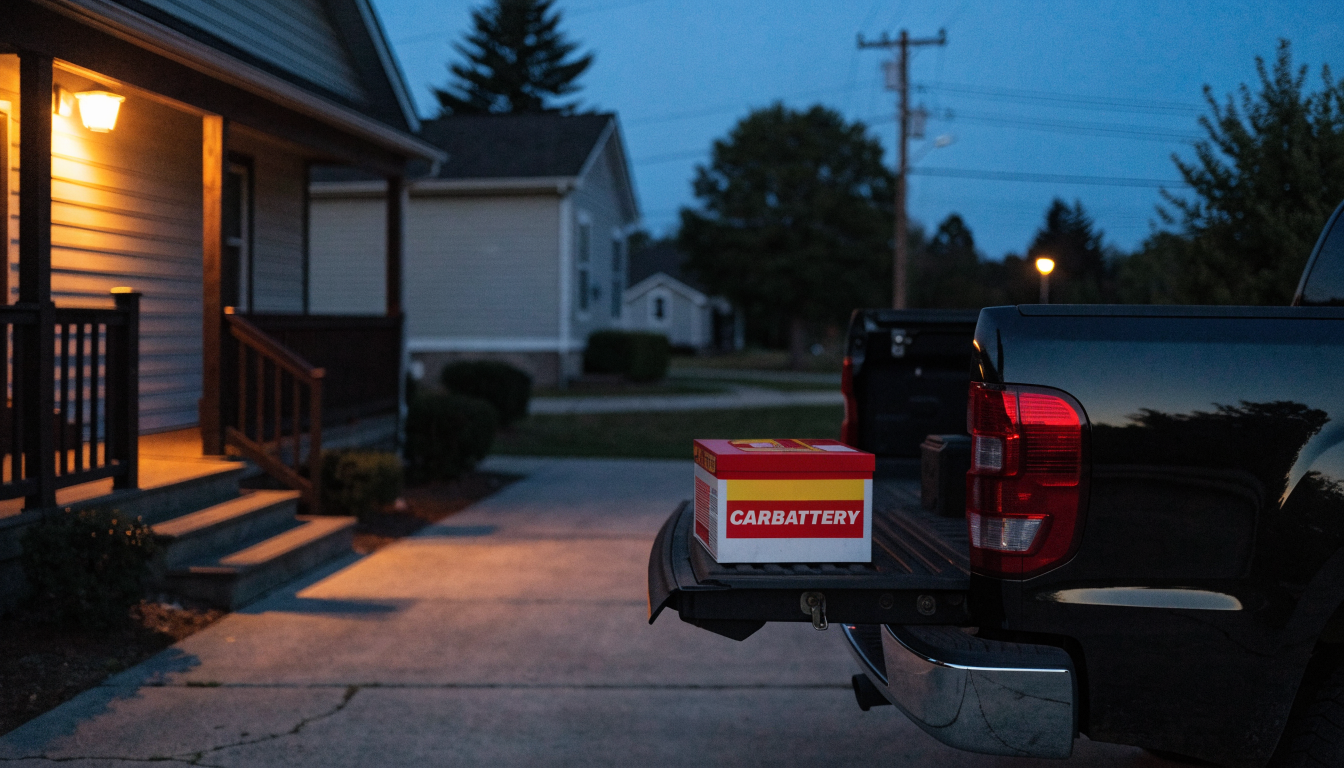
The EverStart battery warranty is Walmart's own cover for its house-brand 12-volt batteries, and it ranges from one year of free replacement on the Value line to three years free plus a further prorated period on the Maxx line. None of it applies to your EV's main battery. EverStart makes conventional lead-acid and AGM starter batteries, the same job a car's 12V battery has always done, EV or not. If a low-voltage warning sent you here, replacing that part is cheap and quick. The pack that actually drives the car is a separate item, and it is covered by the vehicle maker, not by Walmart.
Why a receipt from Walmart raises questions about a much bigger part
Buying a 12V battery at Walmart is an ordinary, five-minute errand for most drivers. For a new EV owner, it can trigger a moment of doubt: does a warranty this short really cover something this important? The honest answer is that it was never meant to. EverStart's warranty covers a battery costing a fraction of what the traction pack under the floor is worth, and the two are unrelated parts with unrelated paperwork.
That confusion has a simple root cause. Petrol drivers only ever deal with one battery. EV owners have two: a small 12V unit doing the everyday electrics, and a large high-voltage pack doing the actual driving. A cheap, short-warranty part like an EverStart battery is entirely normal for the first. It would be alarming for the second, which is exactly why manufacturers back that part with far longer, far more detailed cover instead.
Why EverStart's terms step up by tier
Value and Plus: the entry tiers
EverStart Value, the cheapest line, carries one year of free replacement. EverStart Plus doubles that to two years. Both use standard flooded lead-acid construction, built to a price point rather than to a performance spec.
Maxx: free years, then a prorated stretch
EverStart Maxx is the tier most drivers actually buy. It carries three years of free replacement, and then a further prorated period rather than the cover simply ending. Fail inside the first three years, and you get a free swap. Fail after that, inside the prorated window, and you pay a reduced price rather than the full retail cost.
Platinum: the AGM option
EverStart Platinum, an AGM battery built for cars with heavier electrical loads, carries a longer flat-term warranty than the Value and Plus lines, with the exact length printed on the battery itself rather than standardised across every version. Whichever tier you bought, keep your receipt. Walmart's registration and lookup process leans on proof of purchase more than on the battery itself.
Working out what a prorated claim actually costs you
- Find out which tier you bought. The free-replacement length and any prorated stretch afterwards are both tied to the specific line, not to the EverStart name as a whole.
- Check where you are in the warranty term. Inside the free years, a failure costs nothing. Past that point but still inside the prorated window, expect to pay a reduced share of the current price.
- Understand how proration typically works. Midtronics, which makes the equipment stores use to test batteries, describes a typical structure where a customer pays around half the current retail price in the first year past free cover, then a smaller share the year after. EverStart's own three-free, two-prorated shape follows exactly this pattern.
- Bring proof of purchase. A pro-rated credit is calculated against the battery's age, so the date on your receipt directly decides what you pay.
- If it is not the 12V battery at all, stop pricing this warranty. A range drop, a high-voltage fault light, or a "main battery" service message points to the traction pack, and that is priced and warrantied on an entirely different scale.
- Compare against the manufacturer's own traction-pack terms before assuming any cost. A Jaguar I-Pace's high-voltage pack, for example, is covered for eight years or 100,000 miles against a 70% capacity floor, a completely different kind of promise from a parts-store proration schedule.
A worked example of what a prorated claim looks like
Say an EverStart Maxx battery fails in its fourth year, just past the three years of free cover. Following the typical prorated structure Midtronics describes, roughly half the current retail price is credited towards a replacement, so you pay the remaining half rather than buying a battery from scratch. Wait until year five, still inside the prorated window, and the credit typically drops further, so you pay a larger share again. The exact percentage depends on Walmart's own schedule at the time of the claim, but the shape is consistent: the longer you wait past the free period, the less credit is left.
What a Maxx battery costs you, year by year
| Year of ownership | Cover status | Typical cost to you |
|---|---|---|
| Years 1-3 | Free replacement | Nothing, aside from the original purchase |
| Year 4 | Prorated | Roughly half of current retail, on the typical schedule Midtronics describes |
| Year 5 | Prorated, lower credit | A smaller share of current retail than year 4 |
| Year 6 onward | Warranty ended | Full retail price, same as buying new |
Line this up against your own receipt date, and you can tell at a glance which row you are actually in, rather than assuming the whole warranty has already lapsed. Walmart can adjust the exact prorated percentages at any time, so treat this table as the shape of the deal as of August 2026, and confirm the live figure in-store before paying.
That structure is worth comparing side by side with a UK equivalent. Halfords sells 12V batteries with guarantees of one, three, four or five years depending on the specific product, and its guarantee does not step down gradually the way EverStart's prorated period does; you are either inside the stated term or you are not. Neither approach is better in every case. A flat term is simpler to reason about. A free-then-prorated term can pay out further into a battery's life, just at a reducing rate.
What it costs if this turns out to be the wrong part entirely
A 12V battery claim, prorated or not, is a small sum next to a genuine traction-pack problem. Tesla's battery and drive unit warranty runs eight years, and up to 150,000 miles depending on the model, with a guaranteed minimum of 70% capacity retained. That is the kind of promise a car maker makes on a component that can cost thousands to replace outright, not the sort of cover a parts-store battery ever carries. If you are trying to work out whether your own Tesla's pack is actually ageing normally, Tesla battery life walks through real fleet data rather than a single average figure.
When a new 12V battery does not solve the problem
If a freshly warrantied EverStart battery goes flat again within days, the battery is rarely to blame a second time. A parasitic drain somewhere in the car, or a DC-DC converter not topping the 12V battery back up correctly, produces the exact same symptom. Replacing the battery again will not fix either fault. A short battery health check on the main pack is worth doing at that point too, mostly to rule out the more expensive part before you spend more money on the cheap one.
What to do next
If it is the 12V battery, an EverStart claim under the terms above is routine, and knowing your tier and purchase date is most of the work. If it is the traction pack, start with the manufacturer's own warranty rather than any parts-store schedule. It is also worth reading how EV tyres wear faster than most drivers expect and the basics of caring for your EV's main battery, since both are consumables that quietly cost owners money long before a dashboard warning appears. If your own battery carries a different retailer's badge, our Super Start battery warranty guide covers O'Reilly's version of the same free-replacement structure, and our wider EV ownership guides cover most of what comes up in the years between one battery and the next.
Sources
Common questions
What is the Tesla battery warranty, and how does it compare with EverStart's?
Tesla's warranty covers the high-voltage traction pack for 8 years and up to 150,000 miles, guaranteeing at least 70% of original capacity. EverStart's warranty is entirely different: a 1 to 5-year cover on a cheap 12V accessory battery from Walmart, with a prorated stretch on some tiers, and no connection to the traction pack.
What is the Porsche EV battery warranty?
Porsche covers the high-voltage battery in its electric models for 8 years or 100,000 miles, guaranteeing at least 80% of original capacity for roughly the first three years, then a 70% floor for the rest of the term. This sits entirely apart from any 12V battery, EverStart or otherwise.
What is the Halfords battery warranty in the UK?
Halfords sells 12V batteries under guarantees of 1, 3, 4 or 5 years depending on the product, playing a similar role in the UK to EverStart's in the US. Neither ever covers an EV's high-voltage traction pack, which is the vehicle manufacturer's responsibility instead.
What is the Jaguar I-Pace battery warranty?
The Jaguar I-Pace's high-voltage battery is covered for 8 years or 100,000 miles, claimable if capacity drops below 70% of the original figure. This is a manufacturer warranty on the traction pack, separate from any 12V accessory battery fitted to the car, EverStart included.
What does a typical car battery warranty prorated period actually mean?
A prorated period means cover does not simply end after the free-replacement years; it steps down instead. Typically, a customer pays a reduced share of the current retail price if the battery fails during this stretch, rising back to full price only once the entire warranty term has passed.
What is the BMW battery warranty on an electric model?
BMW backs the high-voltage battery in its electric models for 8 years or 100,000 miles against manufacturing defects, with a capacity guarantee added for some certified pre-owned models. This is unrelated to any 12V accessory battery, including an EverStart unit fitted at a parts counter.
About the author
ElectraMile EditorialEditorial desk
The ElectraMile editorial team covers charging, running costs and EV ownership for readers in the UK and US.
Spotted something wrong? Tell us — we correct and date every change.
Figures shown for United Kingdom in GBP. Switch market in the header to see local pricing and terminology.