Super Start Battery Warranty Explained (It's Not Your EV's)
O'Reilly's Super Start battery warranty runs one to four years by tier, covers only your car's 12V battery, and has nothing to do with the pack that drives an EV.
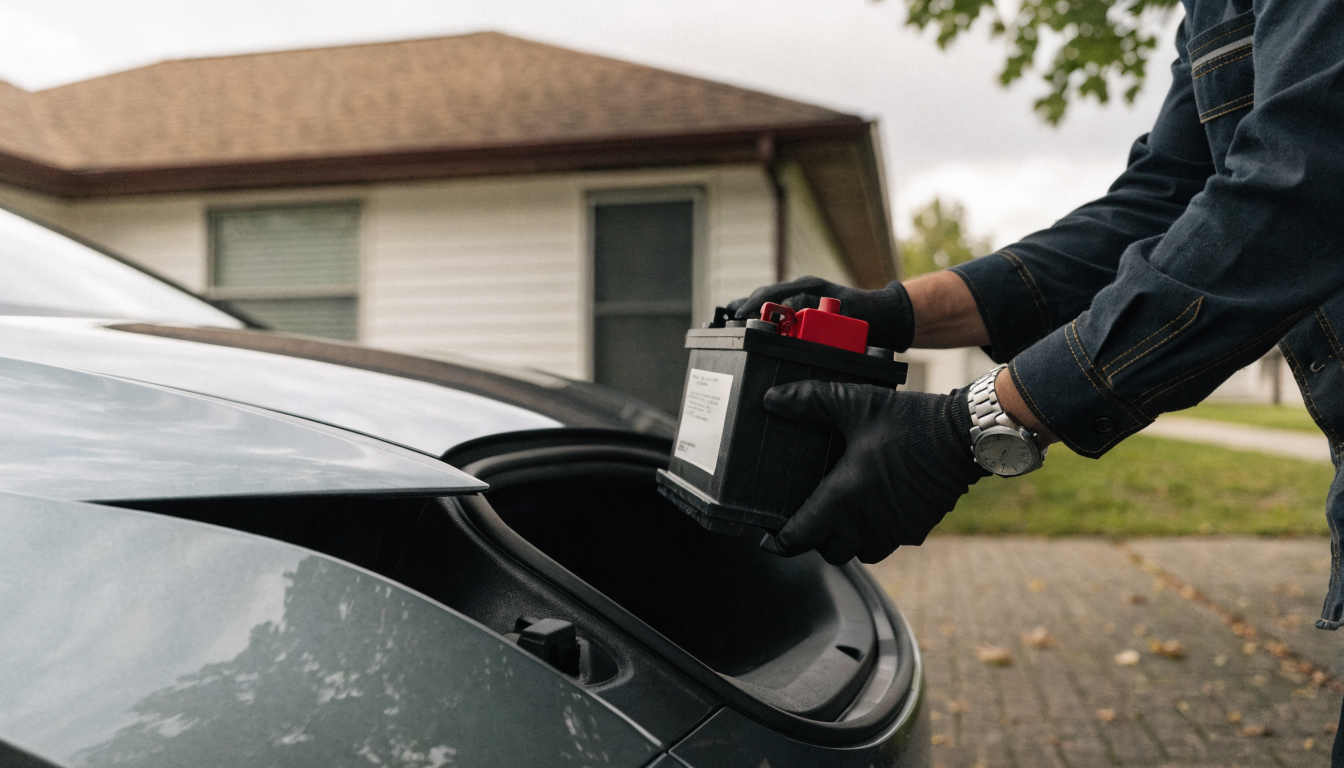
The Super Start battery warranty is O'Reilly Auto Parts' own free-replacement cover, running one to four years depending on which Super Start tier you bought. It has nothing to do with your EV's main battery. Super Start batteries are 12-volt lead-acid or AGM units, built for starting an engine or running a car's electrics, the same job a 12V accessory battery does in an EV. If your dashboard threw up a low-voltage warning and this is why you searched, replacing that battery is a routine, same-day job. Your EV's actual traction pack is a separate, far more expensive part, and it carries a completely different warranty from the vehicle maker.
Why one search brings up two unrelated batteries
Search "super start battery warranty" straight after "how long does my EV battery last" and the results blur together. Nothing on the page explains that these are different products from different companies, sold for different jobs. That mix-up is easy to fall into, because most drivers coming from a petrol car have only ever owned one type of battery in their life.
An EV owner's confusion is fair, though, because the EV genuinely does carry two batteries. One is a small 12V unit, doing the same job it always did: waking the car up, running the lights, and letting the high-voltage system switch on in the first place. The other is the large pack under the floor that actually drives the wheels. A flat 12V battery is one of the most common reasons an EV refuses to start, and it is entirely unconnected to the pack that gives the car its range. Our wider set of EV ownership guides covers both, but they are never the same conversation, and treating them as one problem is how owners end up quoted for the wrong repair.
Why Super Start warranty terms vary so much by tier
O'Reilly sells several grades under the Super Start name, and the free-replacement period is tied directly to which one you bought, not to the brand as a whole.
Standard flooded batteries
Super Start Economy carries a one-year free replacement. Super Start Premium, a step up in build quality, doubles that to two years. Both are conventional flooded lead-acid batteries, the same basic design used in most petrol cars for decades, and neither is built with an EV's electronics in mind specifically.
Extreme and Platinum tiers
Super Start Extreme, built with reinforced grids for harsh climates, carries three years of free replacement. Super Start Platinum, an AGM (absorbed glass mat) battery designed for cars with heavy electrical loads or start-stop systems, runs three to four years. None of O'Reilly's current Super Start warranties are prorated. A battery that fails in month 35 of a 36-month term is still replaced at no cost, rather than at a discount, which is worth knowing before you assume the worst about a late failure.
How to work out which warranty actually covers your problem
- Check what the car is actually telling you. A car that will not power on at all, or a plain "12V battery" or "low voltage" alert, points to the small accessory battery. A range warning, a high-voltage fault message, or anything mentioning the "main" or "traction" battery points to the pack instead.
- Read the label on the battery itself, not a general warranty page. The free-replacement period is printed on the battery, and it is specific to the tier you bought, not to the Super Start brand as a whole.
- Keep your receipt, or your phone number on file with O'Reilly. A warranty claim is processed by testing the battery in-store, and O'Reilly can usually look up a purchase using the phone number given at checkout if the receipt is lost.
- Expect a conductance test before any free swap. Staff test the battery rather than take your word for it. A result of "good, just needs charging" means the claim is declined; a result of "bad" means a free replacement inside the warranty period.
- If it is the traction pack, ignore parts-store warranties entirely. Go straight to the manufacturer's own terms. Reading how Tesla battery life actually holds up over real mileage is a better starting point than any receipt from a parts store.
- Never accept a vague "battery replacement" quote from a garage. Ask which battery, specifically. The price gap between a 12V swap and a traction-pack repair is enormous, and the phrase alone does not tell you which job you are being quoted for.
Which warranty applies to your situation
| Your situation | Warranty that applies | Typical length |
|---|---|---|
| Car won't power on, "12V battery" alert | Super Start (tier printed on the label) | 1-4 years, free replacement |
| Reduced range, no start-up fault | Vehicle maker's traction-pack warranty | Usually 8 years |
| UK reader, 12V accessory battery | Halfords or an equivalent retailer | 1-5 years by product |
| Tesla, high-voltage system fault | Tesla battery and drive unit warranty | 8 years / 100,000-150,000 miles, min 70% |
| BMW electric model, high-voltage fault | BMW high-voltage battery warranty | 8 years / 100,000 miles |
Nothing in the top three rows overlaps with the bottom two. A parts-store warranty can never be used against a traction-pack fault, and a manufacturer's traction cover will never pay out for a flat 12V battery. Each is a separate claim, to a separate party, with its own paperwork.
What each type of failure actually costs
A Super Start replacement is one of the cheapest jobs a garage or parts store handles, usually finished in the same visit regardless of what car it goes into. A traction-pack fault sits on a completely different scale of cost and complexity. Knowing which one applies before you agree to any work avoids paying diagnostic fees twice, or worse, approving the wrong repair entirely on a technician's say-so.
This gap in scale is also why manufacturers guard traction-pack warranties so carefully compared with a retailer's simple swap policy. BMW backs its electric models' high-voltage pack for 8 years or 100,000 miles against manufacturing defects, the same broad shape as Tesla's own cover. Neither company would offer that on a part costing a few hundred pounds; both do, because the part behind it costs many thousands. If you also own a Tesla and want the fuller cost picture once a car is out of warranty, our guide to caring for the main EV battery day to day is the better next stop than any parts-store page.
When a fresh battery is not the real fix
If a new Super Start battery goes flat again within weeks, the battery itself is rarely the cause. A parasitic drain, a faulty DC-DC converter that is not topping the 12V battery up properly, or software keeping the car partly awake overnight can all repeat the same symptom straight after a warranty swap. Replacing the battery a second time will not fix any of those. If the fault comes straight back, get the charging system checked before buying a third battery, since the pattern itself is the real clue.
It is also worth ruling out the traction pack directly rather than guessing. A short, standalone battery health check confirms whether the main pack is contributing to the symptom at all, before you spend more money chasing the wrong part.
What to do next
If the fault points to the small 12V battery, a Super Start swap under warranty is routine, and the terms above are standard across O'Reilly stores nationwide. If it points to the traction pack instead, start with the vehicle maker's own warranty, not a parts-store return policy. It is also worth knowing that AAA-branded batteries follow a broadly similar structure at other retailers; see our AAA battery warranty guide if that is the label on the one you are holding. And once the 12V question is settled, EV tyres wearing faster than expected is the other quietly expensive consumable worth checking while you are under the bonnet.
Sources
Common questions
What is the Tesla battery warranty, and is it the same as a Super Start warranty?
No. Tesla's battery warranty covers the high-voltage traction pack that drives the car, for 8 years and up to 150,000 miles depending on the model, guaranteeing at least 70% of original capacity. A Super Start warranty covers only the car's separate 12V accessory battery, for 1 to 4 years depending on tier, at a fraction of the value.
What is the Porsche EV battery warranty?
Porsche covers the high-voltage battery in its electric models for 8 years or 100,000 miles. It guarantees at least 80% of original capacity for the first three years or 38,000 miles, then a 70% floor for the remainder of the term. This is entirely separate from any 12V accessory battery fitted to the car.
How does the Halfords battery warranty compare with Super Start's?
Halfords sells 12V batteries with guarantees of 1, 3, 4 or 5 years, depending on the specific product, covering manufacturing defects in that battery alone. Like Super Start, it has no connection to an EV's high-voltage traction pack, which is covered instead by the vehicle manufacturer's own, much longer warranty.
What is the Jaguar I-Pace battery warranty?
The Jaguar I-Pace's high-voltage battery is covered for 8 years or 100,000 miles, whichever comes first, and the warranty becomes claimable if capacity falls below 70% of the original figure. As with other manufacturers, this sits entirely apart from any 12V accessory battery fitted to the car.
What does a typical car battery warranty cover?
A typical car battery warranty, for a conventional 12V unit, runs 1 to 5 years, usually with a free-replacement period followed by a prorated stretch at some retailers. It covers manufacturing defects in that specific part only, never an EV's separate high-voltage traction pack, which carries its own, much longer manufacturer warranty.
What is the BMW battery warranty on an electric model?
BMW backs the high-voltage battery in its electric models, including the i4, i5, i7 and iX, for 8 years or 100,000 miles against manufacturing defects. This is a vehicle manufacturer warranty on the traction pack, entirely separate from any 12V accessory battery, including a Super Start replacement fitted at a parts store.
About the author
ElectraMile EditorialEditorial desk
The ElectraMile editorial team covers charging, running costs and EV ownership for readers in the UK and US.
Spotted something wrong? Tell us — we correct and date every change.
Figures shown for United Kingdom in GBP. Switch market in the header to see local pricing and terminology.