Tesla Model Y RWD: Standard vs Long Range, worth it?
Two rear-wheel-drive Model Y trims sit £3,000 apart. This guide works out the real kWh, charging cost and cost-per-mile difference to see if the Long Range earns its price.
DisclosureSome links on this page earn ElectraMile a commission. It never changes what we recommend.
The Tesla Model Y RWD line-up has two trims, and the Long Range costs £44,990 in the UK, £3,000 more than the entry Standard. That extra money buys 69 more miles of WLTP range and a bigger, roughly 79kWh usable battery. A full charge from empty costs roughly £20.63 on a standard electricity tariff, or about £6.32 overnight on a cheap EV rate. Whether that extra range is worth £3,000 depends entirely on how many miles you actually drive.
What "Tesla Model Y RWD" buyers are really asking
Typing "Tesla Model Y RWD" rather than just "Tesla Model Y" usually means one thing: you already know you do not need all-wheel drive, and you are trying to work out which of the two rear-wheel-drive versions to buy. That is a narrower, more useful question than the general "what does a Model Y cost" search, and it deserves a narrower answer.
Tesla brought the Long Range RWD to the UK in February 2026, replacing an earlier long-range rear-drive car and slotting in at £3,000 above the entry Standard RWD and £4,000 below the Premium Long Range AWD. The maths below works out whether that middle position earns its price.
This guide sticks to the two rear-wheel-drive trims rather than the whole Model Y range. If all-wheel drive is genuinely on your shortlist too, our used EV buying guide is a better starting point for weighing a nearly-new AWD car against a brand-new RWD one at a similar monthly cost.
Why the Long Range RWD costs what it does
A bigger battery, not a second motor
Both RWD trims use a single rear motor. The price and range gap between them comes entirely from battery size. The Long Range pack is understood to hold around 79kWh usable, against roughly 57-62kWh on the Standard RWD. These are independent estimates, since Tesla does not publish the exact figures itself. That larger pack is also why the Long Range RWD can accept faster DC charging, up to around 250kW against the Standard car's lower peak rate.
The range gap is real, not just a marketing number
WLTP range rises from 314 miles on the Standard RWD to 383 miles on the Long Range RWD, a genuine 69-mile improvement. Real-world efficiency for the Long Range RWD sits at roughly 4 miles per kWh in mixed driving, according to independent efficiency data, which is close enough to the WLTP figure that the claimed range is not wildly optimistic on this trim.
0-60mph is quick, but that is not really the point of this trim
The Long Range RWD does 0-60mph in about 5.4 seconds, a full second quicker than most family SUVs despite its single motor. It exists for range and efficiency, not outright pace. Buyers wanting genuine speed should look at the AWD or Performance trims instead, both of which cost more and give up some of this trim's efficiency advantage.
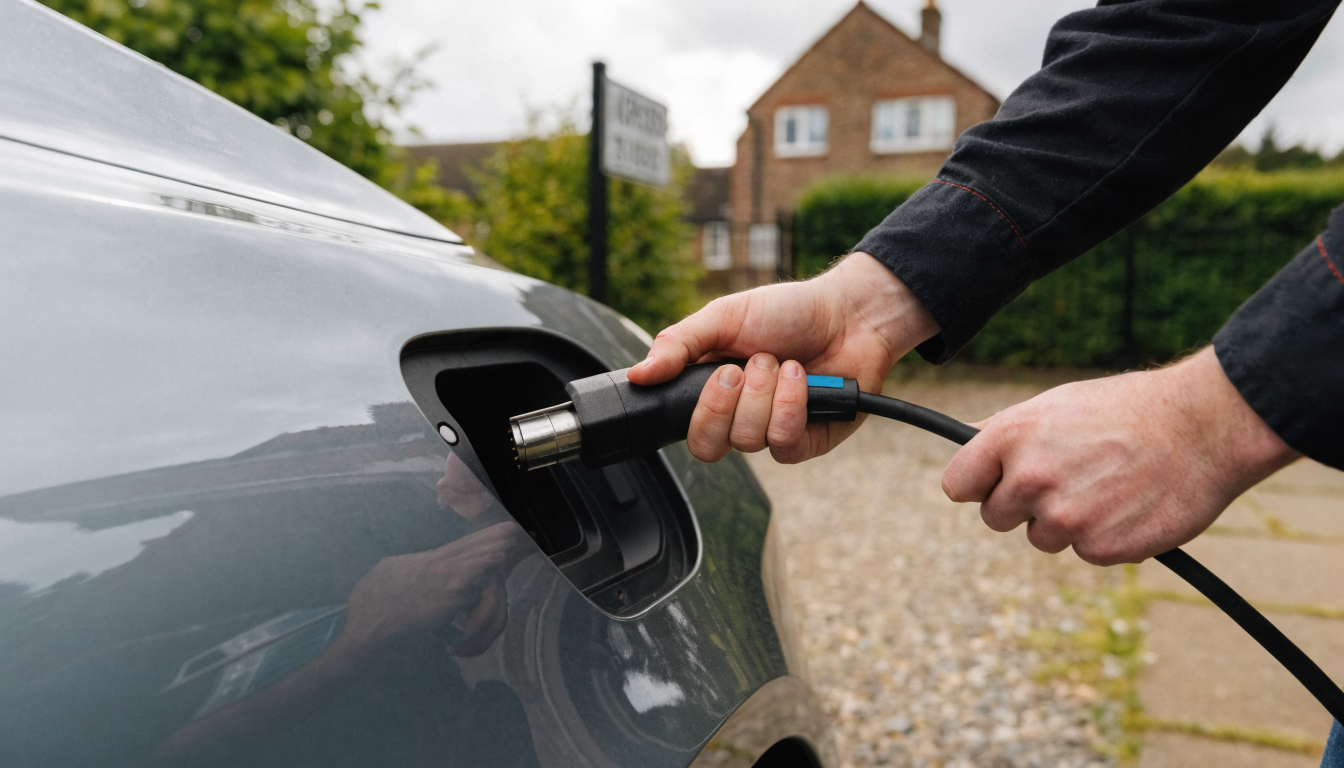
The charging port sits on the near-side rear flank on every current Model Y, whichever trim you choose. It takes a Type 2 connector for home and public AC charging, and the same socket handles CCS for DC rapid charging. Nothing about that changes between the Standard and Long Range RWD cars, so the only real charging difference is how much energy the bigger battery can accept, and how quickly.
Neither RWD trim is a dedicated tow car, since a single motor driving the rear wheels gives up some of the stability an all-wheel-drive setup offers with a loaded trailer behind it. If towing is genuinely part of the job, our best electric cars for towing guide is worth checking before you commit to either RWD trim on range and price alone.
Working out whether the extra £3,000 is worth it
1. Calculate your own cost per charge first. The Long Range RWD's roughly 79kWh usable battery, multiplied by the July-September 2026 Ofgem price cap rate of 26.11p per kWh, gives 79 × 26.11p = £20.63 for a full charge from empty. On a cheap overnight tariff at 8p per kWh, the same charge is 79 × 8p = £6.32.
2. Work out your cost per mile at real-world efficiency. At roughly 4 miles per kWh, the standard-rate cost per mile is 26.11p ÷ 4 = 6.53p. On the cheap overnight rate, that drops to 8p ÷ 4 = 2p a mile. Multiply either figure by your annual mileage to see what you would actually spend running one.
3. Compare that to a realistic annual total. A driver covering 10,000 miles a year on the cheap overnight rate spends roughly 10,000 × 2p = £200 in electricity. On the standard daytime rate, that rises to 10,000 × 6.53p = £653. Either way, the gap between the two tariffs matters far more to your annual cost than the choice between Standard and Long Range RWD.
4. Add servicing and tyres before totalling the full picture. Independent UK garages typically charge £135-£210 for a full annual service on a Model Y, regardless of trim. Tyres cost more here than on a lighter car, commonly £200-£280 per corner at independent fitters, because the extra weight and instant torque wear the front tyres faster than a similarly sized petrol SUV.
5. Decide based on your actual weekly mileage, not the biggest number on the page. Suppose your realistic weekly driving sits comfortably inside the Standard RWD's 314-mile range, with charging opportunities along the way. In that case, the extra £3,000 buys convenience and charging speed, not a capability you are actually missing. If you regularly drive further between charges, the Long Range RWD's bigger buffer and faster charging genuinely change how often you need to stop.
Standard RWD vs Long Range RWD
| Standard RWD | Long Range RWD | |
|---|---|---|
| Price (OTR) | £41,990 | £44,990 |
| WLTP range | 314 miles | 383 miles |
| Usable battery (est.) | 57-62kWh | ~79kWh |
| 0-60mph | Mid-6 sec | 5.4 sec |
| Peak DC charging | Lower | Up to ~250kW |
| Full charge cost, standard rate | ~£15 | ~£20.63 |
The Long Range RWD costs more to buy and more to fully charge, but it does more miles per charge and per pound once you account for the bigger battery relative to the extra range it delivers.
What it actually costs across a year of ownership
Take the same 10,000-mile driver from the calculation above, this time adding servicing and tyres. One annual service at £135-£210 adds to the electricity cost. Spread across a few years, tyre wear adds roughly another £250-£350 a year on top. On a cheap overnight tariff, total annual running costs for the Long Range RWD land somewhere around £450-£550, excluding insurance. On the standard daytime rate, the same year of driving costs closer to £900-£1,000.
That gap between tariffs is worth more to your annual bill than almost any other single decision you make about this car, including which RWD trim you buy in the first place.
When the Long Range RWD is not the smarter buy
If you rarely drive more than 30-40 miles a day and can charge at home overnight, the Standard RWD's smaller battery already covers you comfortably, and the £3,000 saved is real money left in your pocket. Do not pay for range you will not use just because the bigger number feels safer.
If most of your charging happens on public rapid chargers rather than at home, the calculation changes substantially. Rapid charging commonly costs 60-80p per kWh, which can push your running cost above what the tariff comparison above suggests, regardless of which RWD trim you choose.
What to do next
For a genuinely different shape of EV at a similar price, compare the Polestar 2 and the Nissan Leaf before committing to a Model Y specifically. Browse the rest of our EV model guides for the wider field before you commit to a deposit.
Sources
- Electrive — Tesla brings Model Y Long Range RWD to the UK
- WhichEV — Tesla introduces Model Y Long Range Rear-Wheel Drive in the UK with 383-mile WLTP range
- EVKX — Tesla Model Y Long Range RWD full specs
- Ofgem — Energy price cap unit rates and standing charges
- myrepaircost.co.uk — Tesla Model Y service cost UK
Common questions
How many kWh does it take to charge a Tesla Model Y?
The Long Range RWD's usable battery is estimated at around 79kWh, so a full charge from empty uses roughly that much energy. The Standard RWD carries a smaller pack, estimated at 57-62kWh usable, since Tesla does not publish the exact figures for either version.
Is the Tesla Model Y Long Range RWD worth the extra money?
It costs £3,000 more than the Standard RWD for 69 extra miles of WLTP range and faster charging. Whether that is worth it depends on your mileage: drivers who rarely exceed the Standard RWD's real-world range get little benefit, while those who regularly drive further gain a genuine buffer.
Where is the Tesla Model Y's charging port?
It sits on the near-side rear flank, built into the leading edge of the rear light cluster, on every current Model Y regardless of trim. It takes a Type 2 connector for AC charging, and the same socket handles CCS for DC rapid charging.
How much does servicing a Tesla Model Y cost?
Independent UK garages typically charge £135-£210 for a full annual service, regardless of RWD trim. With no engine or gearbox to maintain, the main recurring costs are brake fluid, cabin filters and the 12V battery rather than a traditional combustion-car service.
How much do Tesla Model Y tyres cost?
Commonly £200-£280 per corner at independent UK fitters, more than on a lighter car, because the Model Y's weight and instant torque wear front tyres faster than a similarly sized petrol SUV. Shopping around between fitters genuinely affects the total cost across a full set.
Is the Long Range RWD new for 2026?
Yes. Tesla introduced this specific trim in the UK in February 2026, replacing an earlier long-range rear-wheel-drive car and sitting between the Standard RWD and the Premium Long Range AWD on price. It is currently the mid-point of Tesla's Model Y range in Britain.
About the author
ElectraMile EditorialEditorial desk
The ElectraMile editorial team covers charging, running costs and EV ownership for readers in the UK and US.
Spotted something wrong? Tell us — we correct and date every change.
Figures shown for United Kingdom in GBP. Switch market in the header to see local pricing and terminology.