Tesla Wall Connector: Which Version Actually Fits Your Car
Tesla sells three different Wall Connectors under one name: a US-only NACS unit, a dual-plug Universal version, and a Type 2 tethered model for everywhere else. Here is how to tell them apart.
DisclosureSome links on this page earn ElectraMile a commission. It never changes what we recommend.
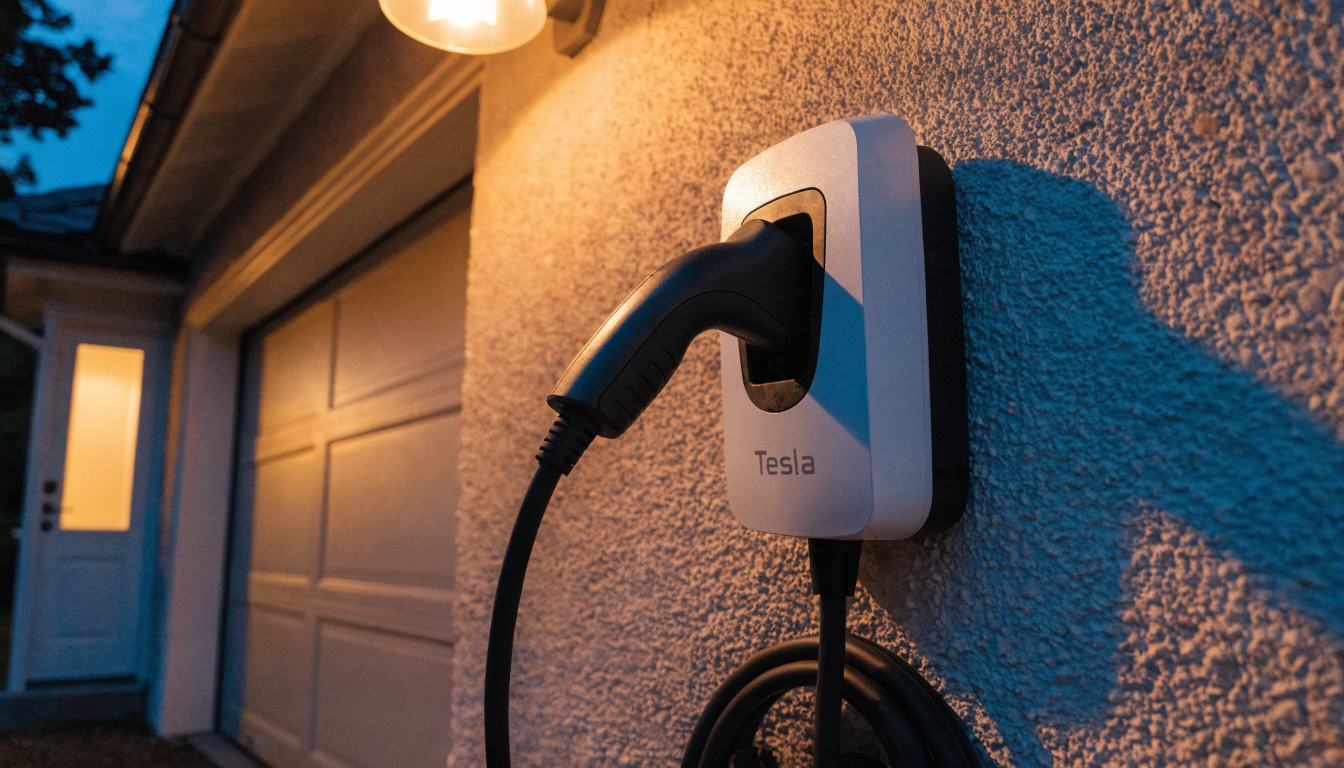
A Tesla Wall Connector is a fixed, hardwired home charging unit. It is not the portable cable that comes in a bag. Which version you need depends on the plug shape your car uses. The Gen 3 only fits Tesla's own NACS plug. The Universal Wall Connector adds a second plug for other cars. Outside North America, Tesla sells a different tethered version instead.
Why "Tesla Wall Connector" means three different products
Search for one and the listings will not agree with each other. Some show a white box with a coiled cable. That cable ends in a small, rounded plug. Others show a near-identical box with a second, chunkier plug clipped to the side. A UK or European listing shows a longer cable again. It ends in a completely different connector shape.
This is not a mistake in the listings. It is three genuinely different products sold under one name. Each is built for different cars and different countries. Buy the wrong one and you pay an electrician to fit a unit your car cannot use. Then you pay again to swap it.
Part of the confusion is recent. Tesla's own plug, once locked to Tesla cars only, is now an open standard. Other manufacturers are adopting it too. "Tesla Wall Connector" and "a wall connector that fits a Tesla" used to mean the same thing. They no longer do. Our charging technology guides cover the wider connector landscape if you want the background first.
Why there are three versions at all
Regions settled on different plugs first
Europe settled on the Type 2 connector for AC charging. It is also called Mennekes, after the manufacturer that designed it. This happened years before Tesla was selling cars there in any volume. North America had no equivalent standard at the time. So Tesla built its own compact plug. It fitted that plug to every Tesla sold in the US and Canada.
Tesla's plug became a public standard
In November 2022, Tesla opened up its connector design. It was renamed the North American Charging Standard, or NACS. SAE International, the body that sets US vehicle engineering standards, is now formalising it as J3400. Ford, General Motors, Rivian and others have since committed to fitting NACS ports on new US models. That is why an NACS-only Wall Connector now makes sense for more than just Tesla owners. If you already own a CCS1 car, what the NACS transition means for CCS owners covers what actually changes for you.
Magic Dock brought a second plug into one unit
Tesla's Supercharger network added a folding J1772 adapter to some charging posts. It is a small clip-on head, permanently attached. Non-Tesla cars could then use those posts without the driver carrying an adapter. The Universal Wall Connector brings the same idea home. One unit, two plug heads. It does not matter which of the two main AC standards your car uses.
How to work out which one you need
-
Check your car's charge port shape. A small, rounded single plug is NACS. A chunkier plug with two extra pins underneath a wider head is CCS1. That is used across most of North America outside Tesla. A wider, seven-pin plug is Type 2, standard across the UK and Europe. If you are not sure, the shape is pictured in your car's manual.
-
Confirm which country you are installing in. North America gets a choice. You can pick the NACS-only Gen 3 or the dual-plug Universal Wall Connector. The UK, Europe and most other markets are sold a tethered Type 2 version instead. There is no NACS option outside North America, because no cars there use that port.
-
Decide whether a second, different EV will ever charge at home. Your household might already run a non-Tesla car alongside a Tesla. It might get one later. The Universal Wall Connector avoids needing a separate charger or a loose adapter hanging off the cable. If every car you own or plan to own takes the same plug, the standard version does the same job for less money.
-
Check what your home's electricity supply can actually deliver. A Wall Connector's rated output only matters if your supply can feed it. Most UK and US homes run a single-phase supply. That limits practical output to around 7kW, even though the hardware itself is rated higher. A three-phase supply is needed to reach the unit's full rated output, and that is uncommon in UK houses.
-
Book a qualified electrician. Every version is hardwired. There is no plug-in option, so this is not a DIY job. A correct installation should leave you with a unit that starts charging within a few seconds of the handle docking into your car. No breakers should trip.
Which Wall Connector fits which car
| Version | Connector | Sold in | Works with | Rated output |
|---|---|---|---|---|
| Gen 3 Wall Connector | NACS only | US, Canada | Tesla and other NACS-equipped cars | 48A / 11.5kW |
| Universal Wall Connector | NACS, plus a docked J1772 head | US, Canada | Tesla, plus any J1772 car, no separate adapter needed | 48A / 11.5kW |
| Wall Connector (Gen 3) | Tethered Type 2 | UK, Europe, most other markets | Any car with a Type 2 port, Tesla included | Up to 22kW on three-phase |
A CCS1 car in North America cannot use a standard Gen 3 Wall Connector for AC charging without a separate adapter. That is because CCS1's AC pins sit under the same J1772 shape its DC pins bolt onto. The Universal Wall Connector's built-in second head solves exactly this case, at a higher price.
What it costs
In the US, the standard Gen 3 Wall Connector lists at around $485. The Universal Wall Connector, with its built-in J1772 head, costs more, at Tesla's own list price of $650, though retailers including Amazon have sold it for $550-600 (9to5Toys, 2026). That extra cost reflects the second connector and slightly more complex electronics inside the unit. Installation is a separate cost again. It typically adds $800 to $3,000, depending on how far the unit sits from your consumer unit or breaker panel, and whether the circuit itself needs upgrading (EnergySage).
In the UK and Europe, Tesla's approved installer network usually quotes the Wall Connector and its fitting together, as one job. The hardware price on its own is rarely shown separately. Get a fixed, written quote before booking. Do not assume a US price converts directly, since UK labour and any consumer unit upgrade are priced separately by each installer.
When a Wall Connector is not the answer
If you rent, or cannot get permission to fix hardware to an external wall, a Wall Connector is the wrong starting point. A portable charging cable that plugs into an existing socket does the same basic job more slowly, without any building work involved.
If you have no off-street parking at all, no home charger solves the problem. You are looking at public charging instead, and the connector questions there are different again. See CCS vs NACS vs Type 2 for how the three main standards relate to one another.
And if what you actually want is faster charging on a long trip, a Wall Connector cannot help at all. That is a DC rapid-charging question, not an AC one. The two behave very differently as a battery fills. Why DC charging slows near 80% explains why the last stretch of any rapid charge takes so much longer than the first.
What to do next
Check your car's charge port shape and your home's electricity supply before requesting a quote. Both determine which version you need and what it can realistically deliver. If your household is likely to run a non-Tesla EV alongside a Tesla, ask specifically about the Universal Wall Connector rather than the standard Gen 3. The standard version cannot charge a J1772 car without an adapter, and that gap catches people out after installation, not before.
Sources
- Alternative Fuels Data Center — Electric Vehicle Charging Stations
- EnergySage — Tesla Wall Connector Gen 3 review
- Electrek — Tesla launches new 'universal wall connector'
- Zap-Map — The complete UK guide to EV charger connector types
- Wikipedia — Combined Charging System
- 9to5Toys — Amazon brings the price down on the Tesla Universal Wall Connector to $550
Common questions
Can a Tesla Wall Connector charge a non-Tesla EV?
Only the Universal Wall Connector can, without extra hardware — it has a built-in J1772 head alongside its NACS plug. The standard Gen 3 Wall Connector is NACS-only, so a non-Tesla car needs its own adapter to use it. The UK and European Type 2 version already fits any Type 2 car, Tesla included.
Is the Tesla Wall Connector sold in the UK the same as the US version?
No. The UK and European Wall Connector has a tethered Type 2 cable and no NACS plug at all, because UK and European cars use Type 2 for AC charging. The US Gen 3 and Universal versions use NACS instead, reflecting the different connector standard used in North America.
Do I need a three-phase electricity supply to use a Wall Connector?
No, but you will not get its full rated output without one. Most UK and US homes run single-phase power, which caps realistic output at around 7kW. Three-phase supplies, less common in homes, unlock the unit's full rated output, up to 22kW on the UK and European version.
Can I plug a Wall Connector into a normal socket?
No. Every version of the Tesla Wall Connector is hardwired directly into your consumer unit or breaker panel by a qualified electrician, with no plug-in option. A portable connector that plugs into an existing socket, such as the Mobile Connector, is a separate product entirely.
Is the Universal Wall Connector worth the extra cost over the standard Gen 3?
Only if you need to charge a non-Tesla car at the same location. The Universal version costs more because it includes a second, built-in J1772 plug. If every car charging there uses NACS, that extra cost buys you nothing you will actually use.
About the author
ElectraMile EditorialEditorial desk
The ElectraMile editorial team covers charging, running costs and EV ownership for readers in the UK and US.
Spotted something wrong? Tell us — we correct and date every change.
Figures shown for United Kingdom in GBP. Switch market in the header to see local pricing and terminology.